Julián Carax
The Shadow of the WindJulián Carax is a Barcelona-born novelist whose nearly vanished books draw Daniel Sempere into an investigation of their author’s life. The surviving accounts present Carax through fragments: a biographical note on a French novel, rumors gathered by a teacher, memories from people who knew him, and the book Daniel adopts in the Cemetery of Forgotten Books. Across those fragments, Carax emerges as a writer whose work survives the obscurity surrounding him, while his departure for Paris leaves behind a personal story that others struggle to understand.
Identity and Background
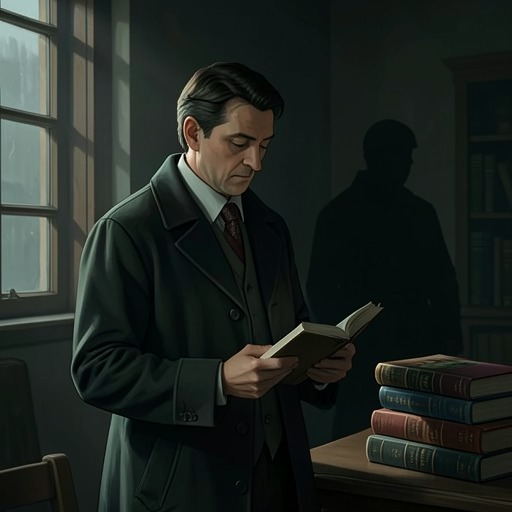
A biographical note accompanying Carax’s first novel describes him as twenty-seven, born in Barcelona at the beginning of the century and living in Paris. He writes in French and earns money at night as a pianist in a hostess bar. The account identifies him as an unknown author, and the book’s grand claims for his talent contrast with the scant attention his work receives in practice.
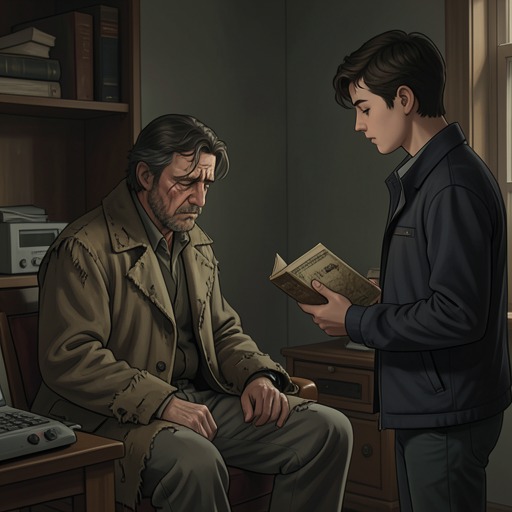
Carax’s family life is presented only through uncertain reports. Isaac says that Carax’s parents had been separated for some time: his mother had gone to South America and remarried, while Carax had apparently not been on speaking terms with his father since moving to Paris. This broken family history is not given as a settled biography; it reaches Daniel through Isaac’s recollection and reinforces how little can be established about Carax from the people left in Barcelona.
Books and the Making of a Reputation
The first Carax novel encountered in the account is The Red House, which a private tutor, Monsieur Roquefort, finds at a secondhand bookstall outside Notre Dame in 1929. Its jacket presents Carax as a daring new talent and advertises a sinister, melodramatic story. Roquefort reads it on a train journey and is deeply moved, but the publisher later tells him that the novel sold exactly seventy-seven copies. Most of those copies, the publisher suggests, went to readers associated with the club where Carax played; the rest were returned and pulped.
Roquefort’s response to the book becomes a sustained act of attention. For ten years he searches Paris secondhand bookshops for Carax’s other works, without finding one. He hears uncertain reports of small editions from small publishers and an unverified title, The Cathedral Thief, but cannot confirm what exists. At the end of 1935, he learns that a Paris firm has published The Shadow of the Wind and writes asking for copies; no reply comes. The pattern is telling: Carax’s books appear, disappear, and resist the ordinary routes by which an author’s reputation might be established.
Daniel’s discovery gives that literary obscurity a new life. In the Cemetery of Forgotten Books, he chooses The Shadow of the Wind, whose title and author he has never heard of, and carries it away as the book he has adopted. Years later, when speaking to Fernando Ramos, Daniel explains that he found a Carax book thought to have disappeared and has since tried to learn about its author and clarify the circumstances of his death. The novel is not simply a clue to Carax’s biography: it is the object that begins Daniel’s inquiry and makes the neglected writer present again.
Love, Friendship, and Departure
The recollections of Carax’s youth place him at the Aldaya house, where he and Penélope first exchange words in its library on a stormy afternoon. For months their closeness develops through brief encounters, furtive looks, and messages passed through Jacinta. Carax writes stories for Penélope from midnight until dawn, then gives the pages to Jacinta to deliver. Penélope sometimes sends notes back, which he rereads for days. Their private exchange grows within the household’s watchful world, while Jacinta, who observes the connection, fears for them.
The relationship also shapes Carax’s conduct toward the Aldayas. To remain near Penélope, he tells Don Ricardo what he expects to hear: he feigns interest in banking and finance and acts as though he is attached to Jorge. Carax understands these performances as a price paid for access to Penélope, and he worries that the compromises are changing him. His imagined alternative is to reject the family’s prospects openly and take Penélope away from the world in which her father has confined her. The evidence records the wish and the concealment that precedes it, not a successful escape together.
Carax’s friend Miquel Moliner helps turn escape into a plan. Because Carax lacks money, Miquel gathers his savings and obtains further funds from his father under false pretexts. They choose Paris: Penélope speaks some French, and Carax learned the language from his mother; Miquel also regards the city as large enough to offer anonymity yet small enough to offer opportunities. The plan is made for the lovers, but the departure scene reveals its painful failure to bring them together.
On Sunday morning, Carax leaves home carrying only a bag of clothes and books. At the Estacion de Francia, he waits with a book, knowing Penélope will not come and that he will board the train accompanied only by memories. Miquel arrives shortly before noon with the tickets and the money he has raised. The friends embrace without speaking; Miquel, whom Carax has never seen cry, weeps. When the last call for Paris is made and the train begins to move, Carax turns to say goodbye while Miquel remains on the platform. The scene makes friendship, rather than the hoped-for reunion with Penélope, the immediate human bond accompanying Carax into exile.
Rumor, Danger, and Disappearance
By 1936, Roquefort’s bookseller friend reports that Carax’s fortunes may have improved. Carax is said to be about to marry a woman of good social standing, and his latest novel has received a favorable review in Le Monde. The apparent change is followed by news of a duel in Père Lachaise cemetery at dawn on the day of the wedding. The circumstances are unclear, but the groom does not reach the church. This is secondhand information, not a complete account of what happened, and its unresolved quality becomes part of the mystery surrounding Carax.
Other testimony places Carax back in Barcelona in 1936 and reports that some people believe he died there. Daniel asks Isaac whether any relatives remain who might know more, only to receive an answer qualified by uncertainty. The narrative likewise reveals a prior threat from Francisco Javier Fumero: during their final school year together, Fumero tried to kill Carax with his father’s shotgun. Miquel intervened at the last moment, and the bullet left a hole near the entrance that Isaac still remembers when he passes it. Isaac says Fumero was obsessed with Penélope and may have acted after seeing Carax kiss her, though he marks this explanation as conjecture.
The scattered accounts resist a clean resolution. Carax is described as returning to Barcelona, rumored dead, associated with a duel on the morning of his reported wedding, and remembered as the intended victim of Fumero’s attack. Daniel’s search begins precisely because the circumstances of Carax’s death remain unclear. The gaps are not incidental: they explain why the author’s identity and books become matters of inquiry rather than settled history.
Narrative Significance
Carax’s life reaches the reader by way of people who know different portions of it. Daniel supplies the frame of investigation; Isaac offers qualified recollection; the account of Monsieur Roquefort traces the fortunes of the books; and the memories surrounding the Aldaya house disclose the emotional history that Daniel is trying to recover. Their partial knowledge makes Carax both a person in the past and an absence that shapes the present.
The contrast between the fragile circulation of Carax’s books and their persistence in readers’ lives gives his literary story its force. The Red House sells only seventy-seven copies, other titles remain uncertain or unfindable, and yet Roquefort continues searching while Daniel adopts The Shadow of the Wind and pursues its author. Carax’s novels thus survive not through secure fame but through acts of reading, keeping, and asking what became of the person who wrote them. His departure for Paris closes one visible chapter; the unanswered questions around his return and presumed death make the book he left behind the beginning of another.